A low MOQ clothing manufacturer in Bangladesh can help a new brand test demand without committing too much cash to one style. However, “low MOQ” does not mean the same thing at every factory. The workable quantity depends on fabric availability, colour count, garment construction, trims, decoration and the production system behind the order.
For many knitwear programmes, a practical starting point is 300 to 1,000 pieces per style per colour. Specialised small-batch units may accept less, while export factories designed for long production runs may need more. Therefore, the right question is not only, “What is your MOQ?” You should also ask what creates that minimum and what changes could reduce it.
This guide explains how minimum order quantity works in Bangladesh garment production, what different products may require, why low-volume prices rise and how UK startup brands can plan a safer first order.
What a Low MOQ Clothing Manufacturer in Bangladesh Means
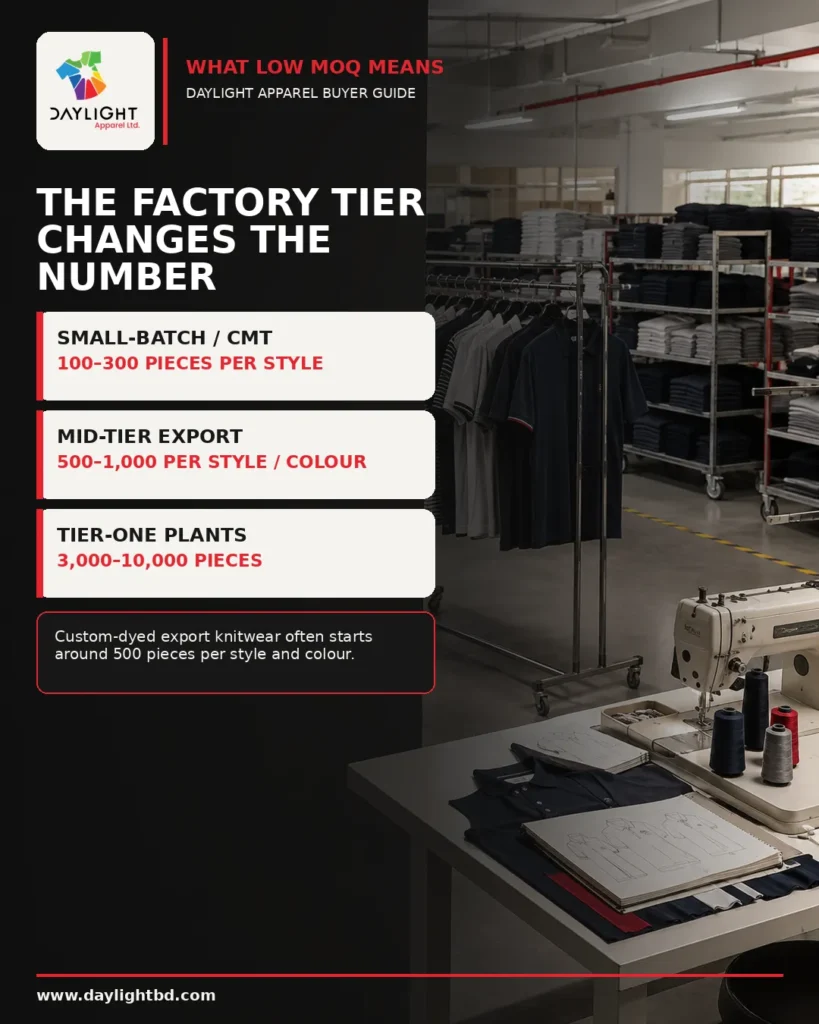
Factory size and production model have a direct effect on minimum order quantity. The ranges below are planning guides, not fixed market rules. Your final MOQ will depend on the specification and the factory’s current capacity.
| Production model | Typical planning range | Best suited to |
|---|---|---|
| Specialised small-batch or CMT unit | 100–300 pieces per style | Market tests, simple products and stock fabric |
| Small to mid-tier export factory | 500–1,000 pieces per style per colour | Private-label knitwear and growing brands |
| High-volume export plant | 3,000 pieces and above | Established retailers and repeat programmes |
A small-batch unit can be useful for an early test. However, it may rely on available fabric, standard trims and simpler construction. In contrast, a larger export factory can offer better unit economics, but its line planning may not suit a very small run.
Before selecting a supplier, review Daylight Apparel’s product range and confirm whether the factory regularly handles your garment category. Product experience matters because a low number alone does not guarantee reliable execution.
Why a Low MOQ Clothing Manufacturer in Bangladesh Sets Minimums
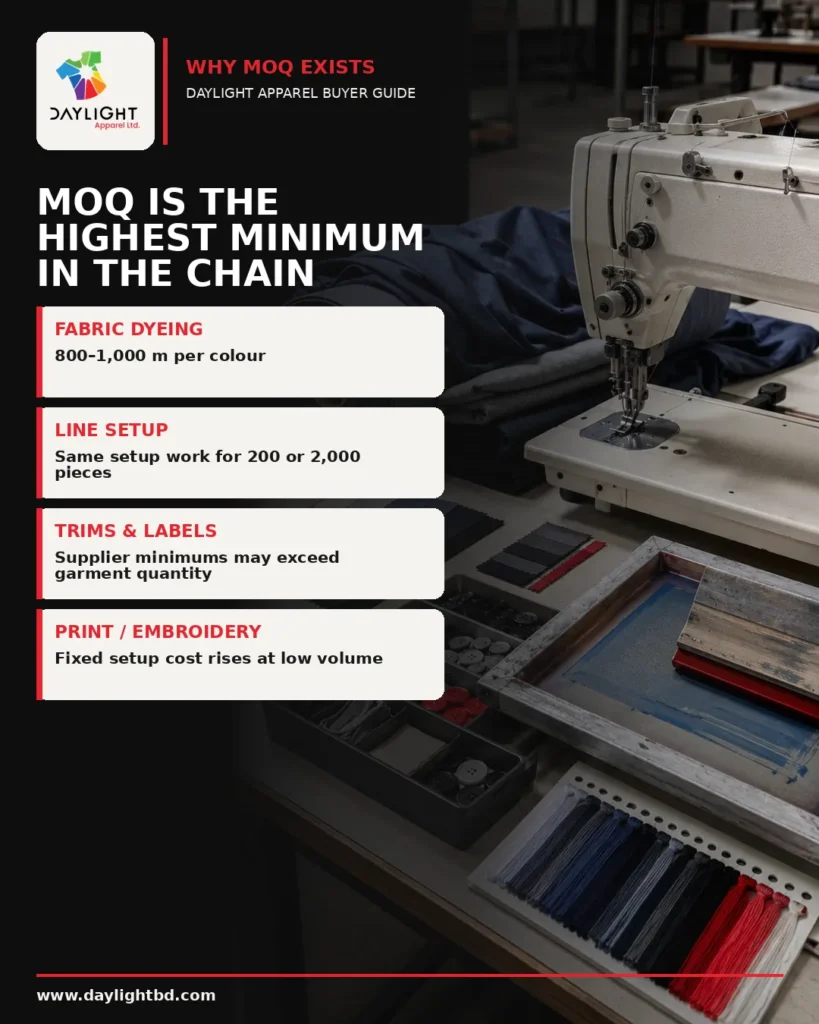
A garment factory’s MOQ is rarely controlled by one department. In practice, the effective minimum is often the highest minimum among fabric, production, trims, printing, embroidery and packaging.
Fabric and dyeing minimums
Custom dyeing is usually the biggest constraint. A dyeing machine needs an economical batch size for each colour. If your garments do not consume enough fabric, the mill may ask you to increase the quantity, pay for unused fabric or select an available stock colour.
This is why 1,000 pieces in one colour can be easier to produce than 1,000 pieces divided across five colours. Every additional colour may require a separate dyeing lot, cutting plan and shade-control process.
Sewing-line setup
A new style requires machine preparation, operator briefing, attachments, test pieces and quality checkpoints. A run of 200 pieces can require much of the same preparation as a run of 2,000. As a result, setup cost becomes much higher per garment when the quantity is small.
Trims, labels and packaging
Buttons, zippers, elastics, woven labels, care labels, hang tags, polybags and printed cartons come from different suppliers. Each supplier may set its own minimum. Consequently, a factory may accept 300 garments while a label supplier requires 1,000 labels.
Printing and embroidery
Screen printing needs screen preparation, while embroidery needs digitising and machine setup. These fixed costs do not fall much when the order becomes smaller. Therefore, complex artwork, many print colours or several placements can raise both MOQ and unit price.
Daylight’s live product pages currently list a 500-piece MOQ for both its premium cotton T-shirt and premium cotton polo shirt. The exact workable quantity still depends on the fabric, colour split, trims, artwork and delivery requirements.
Low MOQ Garment Ranges by Product Type
A low MOQ clothing manufacturer in Bangladesh should review the complete tech pack before confirming a quantity. The ranges below are indicative 2026 planning figures for export-oriented knitwear using custom materials. They are not guaranteed quotations.
| Product | Indicative MOQ per colour | Main factors |
|---|---|---|
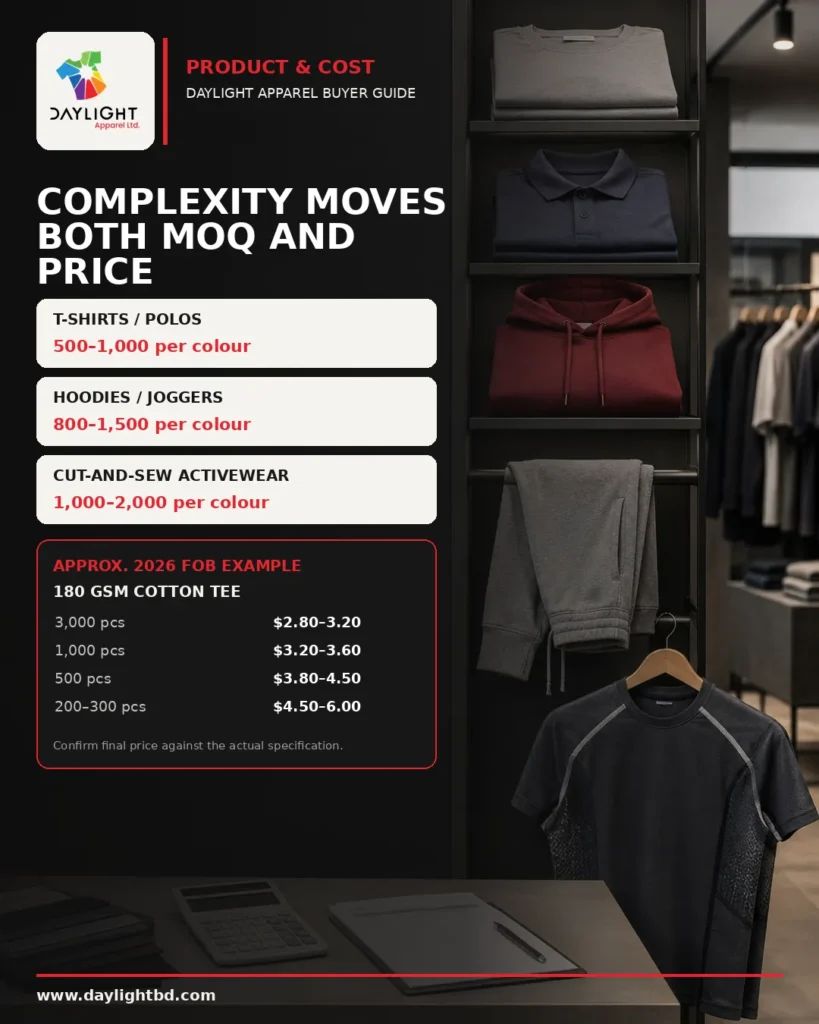
| T-shirt, 160–200 GSM single jersey | 500–1,000 pieces | Standard fabric and simple construction |
| Polo shirt, 200–240 GSM pique | 500–1,000 pieces | Collar, placket, buttons and shade matching |
| Hoodie or sweatshirt, 280–380 GSM | 800–1,500 pieces | Heavy fabric, rib, drawcord and additional trims |
| Jogger or sweatpant, 280–340 GSM | 800–1,500 pieces | Elastic, rib, pockets and heavy fabric consumption |
| Cut-and-sew activewear, 160–220 GSM | 1,000–2,000 pieces | Synthetic fabric, stretch control and performance finish |
Stock fabric may reduce these minimums because it removes the need for a new dyeing lot. However, availability changes frequently. Ask the factory to confirm the exact composition, GSM, shade, usable quantity and replenishment options before approving stock material.
You can also review Daylight’s knitwear production process to understand how material selection connects with knitting, dyeing, cutting, sewing, inspection and packing.
Hidden Minimums to Confirm Before Ordering
The factory’s headline MOQ does not always show the full commitment. Before approving a quotation, confirm these three points in writing.
Is the MOQ per style, per colour or per SKU?
A quote for 500 pieces may mean 500 pieces per style across all colours. More commonly, it may mean 500 pieces per style per colour. Those two definitions create very different total order values.
Does the fabric mill have a separate minimum?
Suppose a factory accepts 500 T-shirts, but the selected custom fabric needs a larger dyeing lot. You may need to raise the garment quantity, pay for excess fabric or hold the balance for a repeat order. Ask who owns the remaining material and how it will be stored.
Will custom packaging create surplus stock?
Branded polybags, tissue, labels and cartons can have higher supplier minimums than the garment order. Decide whether the factory will store the surplus safely or whether a standard packaging option is better for the first run.
Clear answers at this stage protect your budget and delivery plan. They also help the manufacturer build an accurate time-and-action calendar.
What Low MOQ Clothing Production Costs
Lower quantities usually cost more per unit because fixed development and setup costs are divided across fewer garments. Sampling, line preparation, quality supervision, administration and packing still require time, even when the order is small.
For illustration, a standard 180 GSM cotton T-shirt may be planned using the following broad FOB ranges:
| Quantity per colour | Indicative FOB range |
|---|---|
| 3,000 pieces | US$2.80–US$3.20 |
| 1,000 pieces | US$3.20–US$3.60 |
| 500 pieces | US$3.80–US$4.50 |
| 200–300 pieces | US$4.50–US$6.00 |
Treat these figures as planning examples only. Yarn price, fibre composition, GSM, dyeing, wash, print, trims, testing, packing terms and delivery date can change the final quote. In addition, FOB price does not include every landed-cost item for a UK buyer.
Therefore, compare quotations using the same technical specification. A cheaper quote based on different fabric, trims or testing is not a true comparison.
How to Reduce MOQ Without Lowering Quality
The best way to lower MOQ is to remove supply-chain complexity while keeping the product specification clear.
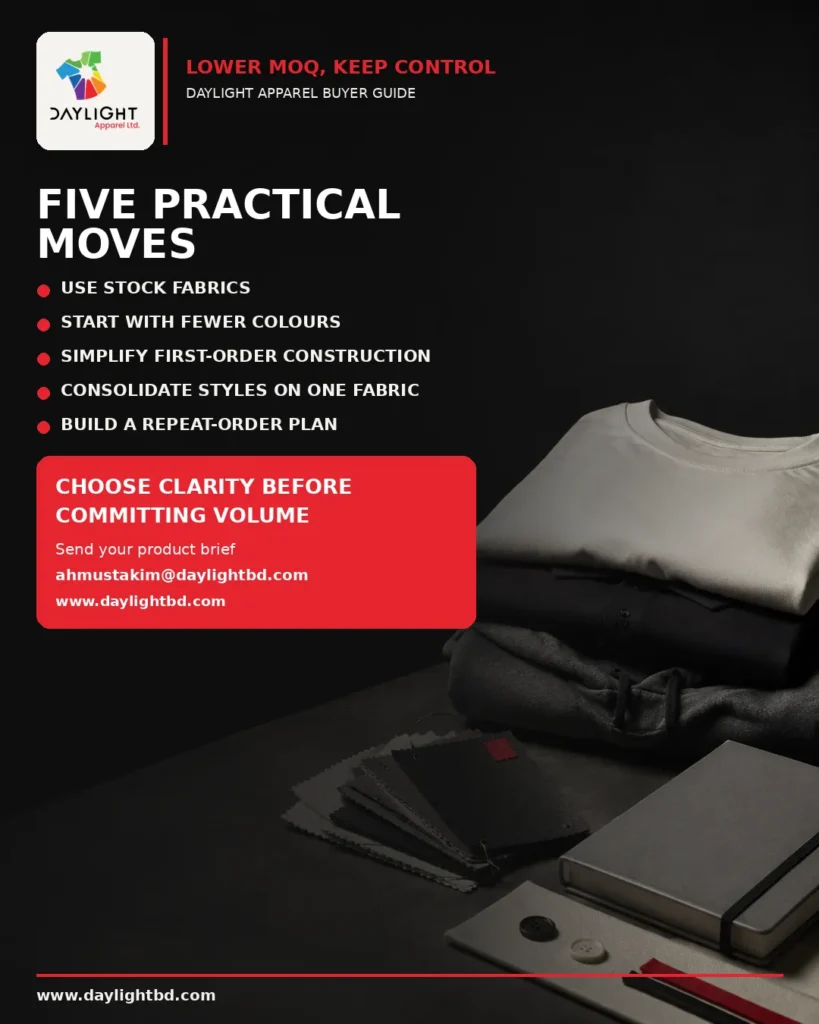
1. Use approved stock fabric
Ask the manufacturer which fabrics and colours are already available. Stock 100% cotton single jersey, CVC, pique or fleece can remove a custom dyeing minimum. Still, approve a physical swatch and confirm available yardage before sampling.
2. Start with fewer colours
Two colours at 500 pieces each are usually easier to plan than five colours at 200 pieces each. Once sales data shows which shades perform, add more colours to the repeat order.
3. Simplify the first version
Use standard trims, fewer artwork placements and proven construction. You can add special washes, custom hardware or complex packaging after the core style has passed its market test.
4. Consolidate styles on one fabric
Several styles can sometimes share the same fabric, GSM and colour. Their combined consumption may help clear a mill minimum. However, the factory must confirm whether the fabric is technically suitable for every style.
5. Plan repeat orders early
Repeat orders are easier because approved patterns, measurements, artwork and trim specifications already exist. Share a realistic forecast, but do not promise volume that the brand cannot support.
A responsible low MOQ clothing manufacturer in Bangladesh will explain which option reduces the minimum and which change could create a quality risk. Daylight also outlines its wider approach to responsible manufacturing on its environmental sustainability page.
Questions to Ask a Low MOQ Clothing Manufacturer in Bangladesh
Use these questions before you pay for sampling or confirm a purchase order:
- Is the MOQ calculated per style, per colour or across the complete order?
- Is the fabric custom dyed or selected from available stock?
- What minimums apply to labels, trims, print, embroidery and packaging?
- What changes would reduce the MOQ without changing the approved quality?
- Will surplus fabric or trims belong to the brand, and how will they be stored?
- Which sample stages are required before bulk production?
- Which tests are recommended for this fabric and intended market?
- What is included in the quoted price and what remains excluded?
- What payment, delivery and claim terms will appear on the order confirmation?
These questions also help you judge communication quality. A manufacturer should explain the trade-offs clearly instead of offering an unusually low number without showing the conditions behind it.
Frequently Asked Questions
Can I order 100 pieces from Bangladesh?
Sometimes. A specialised CMT or small-batch unit may accept 100 pieces, particularly when you use stock fabric, standard trims and simple construction. However, per-unit cost will normally be higher, and custom dyeing may not be practical.
What is a realistic MOQ for custom-dyed knit fabric?
It depends on fabric consumption and the mill’s dyeing capacity. For many standard knitwear programmes, brands should initially plan around 500 pieces or more per style per colour. The manufacturer and mill must calculate the exact requirement from the approved specification.
Does MOQ include all sizes?
Usually, the approved size breakdown can sit inside the MOQ for one style and colour. Nevertheless, very small quantities in one size may affect cutting efficiency. Confirm the size ratio before ordering.
Can repeat orders have a lower MOQ?
They can. Approved patterns, samples, fabric information and trim details reduce development work. Even so, current fabric and supplier minimums still apply, so a lower repeat MOQ is not automatic.
Which compliance documents should a UK brand review?
Ask for current, verifiable documents relevant to the manufacturing site and product. Depending on your requirements, these may include social-compliance audits and material or product certifications. Check the scope, facility name, issue date and expiry date rather than relying on a logo alone. You can learn more about the business on Daylight Apparel’s About page.
Choose Clarity Before Committing Volume
Finding a low MOQ clothing manufacturer in Bangladesh is not only about securing the smallest possible order. The better goal is to find a workable quantity that protects product quality, cash flow and delivery reliability.
A transparent manufacturer will explain the fabric minimum, colour minimum, production setup, trim requirements and price effect before asking you to commit. That information lets a startup brand test demand with fewer surprises and plan a stronger repeat order.
Daylight Apparel supports knitwear development and manufacturing for international buyers. If you are planning a first collection or reviewing a current specification, contact Daylight Apparel and share your tech pack, target quantity, colour breakdown and delivery market for an initial production review.