Understanding fabric consumption in garment manufacturing is the first thing brands and buyers need to get right. The garment looked simple. The costing looked right. Then bulk production started, and the numbers stopped making sense.
Fabric usage crept up. Measurements shifted after wash. Margins quietly disappeared. And before long, the factory was getting blamed for price changes that nobody could properly explain.
But in most apparel production failures, the real problem does not begin on the factory floor. It begins long before a single stitch is made. It begins with inaccurate fabric calculation.
In apparel manufacturing, assumptions are not just wrong. They are expensive.
What Happens Behind the Scenes of the Clothing Order Process
Two garments can look identical and cost completely different amounts to produce
This is where most sourcing misunderstandings begin. A buyer sees the same color, the same silhouette, the same fabric type, and naturally assumes the price should be similar. That is a reasonable assumption. It is also often wrong.
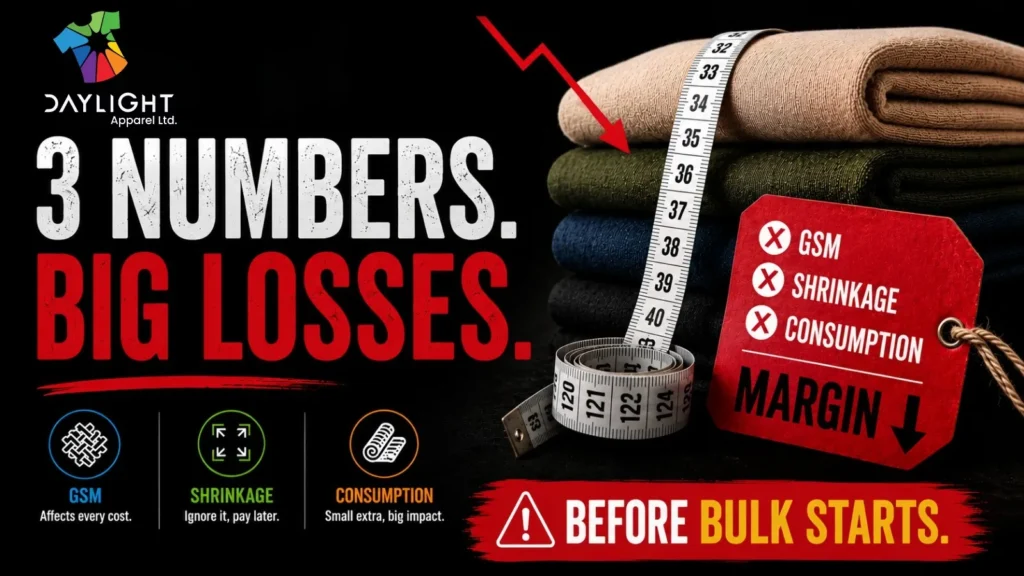
Factories do not calculate garments the way buyers see them. Buyers compare visually. Factories calculate mathematically. A small difference in GSM, shrinkage allowance, or fabric consumption can completely change the fabric requirement, production efficiency, and total FOB cost.
This is why experienced manufacturers ask detailed technical questions before confirming any price. They are not being difficult. They are being accurate.
GSM: the first hidden cost driver in fabric consumption
GSM stands for grams per square meter. It measures how heavy a fabric is. And heavier fabric does cost more per meter, but that is actually the smaller part of the problem.
Higher GSM affects yarn usage, knitting cost, dyeing cost, washing cost, and shipment weight. Two hoodies can look nearly identical in photos and carry completely different production costs because of GSM differences alone.
When a factory adjusts a price based on GSM, it is not padding the margin. The technical requirement changed the cost structure. That is a very different thing.
Shrinkage is where most costing calculations quietly fail
Fabric changes during dyeing, compacting, washing, and finishing. If those changes are not properly accounted for in costing and pattern development, the problems show up later, usually at the worst possible time.
- Garments come out smaller after wash than the approved sample
- Measurements become inconsistent across sizes
- Recutting becomes necessary, consuming extra fabric
- Production efficiency drops and delivery timelines stretch
When this happens, buyers often feel the factory is overcharging. Factories are usually correcting technical losses that were never calculated properly at the start. Both sides end up frustrated over a problem that began in development, not production.
Why fabric consumption in garment manufacturing is the biggest cost variable
Fabric consumption in garment manufacturing is one of the biggest single cost drivers in the industry, and also one of the easiest to underestimate.
| 0.15mextra fabric per piece | 1,500mextra fabric across 10,000 pieces | 3xdownstream cost: dyeing, waste, freight |
Pattern efficiency, fabric width, marker optimization, and garment construction all affect how much fabric a style actually consumes in production. A visually simple design can sometimes be expensive to produce simply because the pattern does not cut efficiently.
Professional manufacturers track this obsessively. It is not technical overcaution. It is the difference between a realistic quote and one that falls apart during bulk.
Why the cheapest quote is often the most expensive decision
One of the most consistent patterns in apparel sourcing is this: the factory that wins on price in the initial round often costs the most by the end of production.
Low quotes happen when shrinkage is ignored, fabric allowance is underestimated, or fabric consumption is calculated incorrectly. Sometimes this is intentional. More often, it is just inaccurate technical work. Either way, the brand ends up absorbing quality issues, price corrections, and timeline delays that were never in the original plan.
Accurate costing is not about being the cheapest. It is about being reliable. The number a factory gives on day one should still hold up on the day goods ship.
The strongest manufacturers are not the ones with the lowest price. They are the ones who calculate correctly before the first stitch is made.
Bangladesh Fast Fashion Revolution: How Daylight Apparel LTD Leads the Way
Fabric is not just a material. It is the foundation of your costing.
When GSM, shrinkage, and fabric consumption in garment manufacturing are not properly evaluated at the start, pricing becomes unstable, production risks increase, and sourcing conflicts become hard to avoid.
The conversations that seem purely technical during development are the exact conversations that protect margin during production.
If you are sourcing apparel from Bangladesh or planning a new production run, the right time to get precise on fabric specs is before the sample, not after bulk has started.