Every factory tour apparel buyer walks away feeling confident. The machines were impressive. The showroom samples were clean. The tour guide had answers before you finished your questions. You left feeling good about the order.
Then bulk production started.
Suddenly the measurements were off. Seam allowances inconsistent. A 3-week delay nobody saw coming. And the question that keeps every sourcing manager up at night: how did we not see this?
You did see it. You just looked at the wrong things.
What Every Factory Tour Apparel Buyer Gets Wrong
This is not about blame. Factory tours serve a real purpose. They give buyers a first impression, help build relationships, and signal genuine investment in the facility. Most factories put real effort into making visitors feel welcome and reassured.
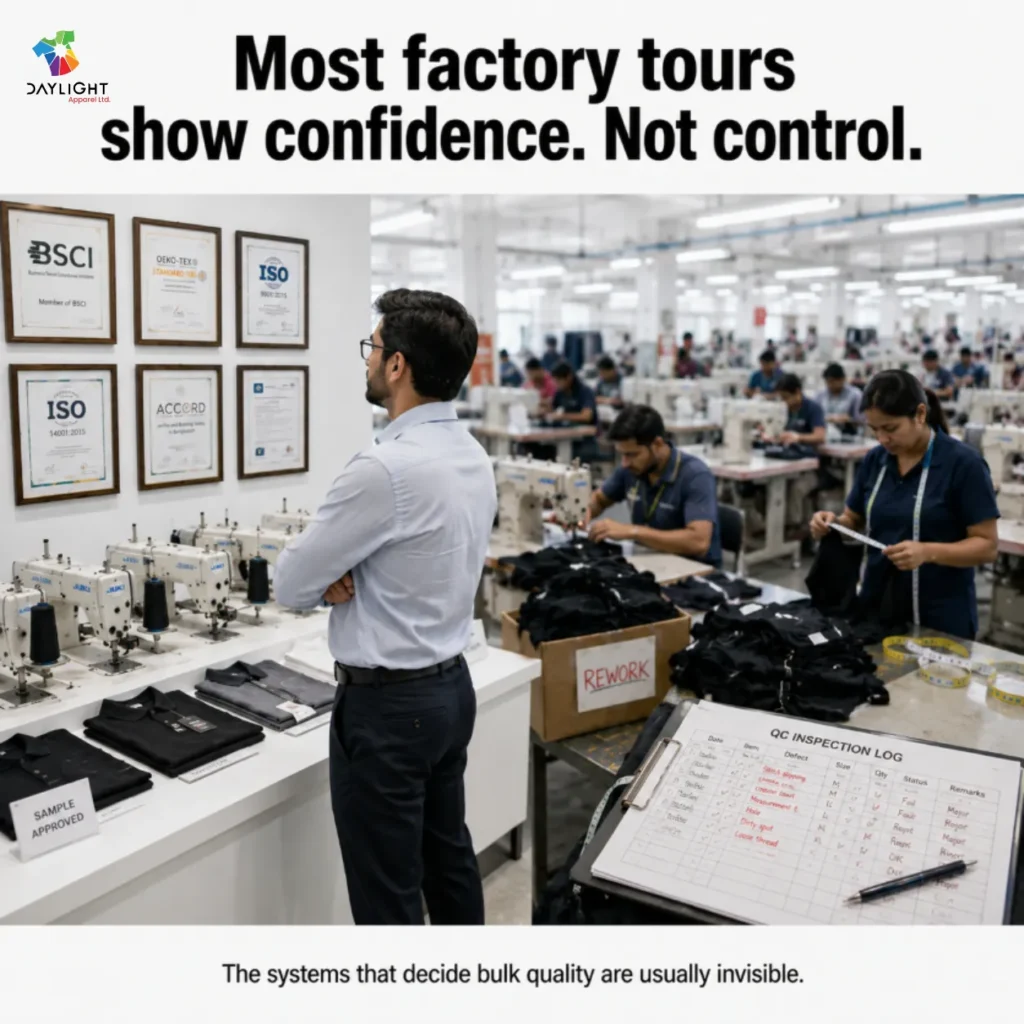
The problem is that confidence is exactly what a factory tour is designed to create. Quickly. The clean walkthrough path. The senior team on hand. The certificates displayed at eye level in the meeting room. These are not accidents. They are choices.
A factory tour is a curated experience. And curation, by nature, leaves things out.
What gets left out is usually where the real story lives. Not because factories are being deceptive, but because the systems that actually determine production quality are invisible unless you know where to look and what to ask.
What a Factory Tour Apparel Buyer Usually Evaluates (And Why It Falls Short)
Walk into a factory audit with most teams and they will tick the predictable boxes. Machine count. Factory size. How polished the presentation felt. Whether the walls had certificates or the samples looked good. Whether the factory manager seemed confident.
None of that tells you how your order will actually run.
A factory with 200 machines can still have a chaotic cutting floor. A large modern facility can still have no system for catching measurement drift before it compounds across 5,000 units. A confident manager can still be running a floor where rework piles go untracked for days.
Certificates get framed. They do not run production lines.
The showroom sample was built by the best operator, with the best fabric, on the best day. What you need to see is what happens on a Tuesday afternoon in week three of a production run when the floor is tired, the trim is running short, and a supervisor is out sick. That is when you find out what a factory actually is.
What an Experienced Factory Tour Apparel Buyer Looks For Instead
What separates an experienced factory tour apparel buyer from the rest is not industry knowledge. It is knowing which questions to ask and where to look.
They start in the cutting room. Not to see whether it is tidy, but to understand whether fabric has been properly relaxed before spreading. Woven fabrics typically need 24 to 48 hours of relaxation depending on fiber content and construction. Skip that step and you are building shrinkage directly into the cut panels. The garment looks fine leaving the factory. It comes back from the first wash a size smaller.
They also check marker accuracy against the approved pattern grading before the blade runs. A 2 to 3mm drift in a marker, caught too late, becomes a fit rejection at final inspection. Thousands of units. You cannot un-cut fabric.
They watch how cut panels are handled after the blade. Are pieces bundled and numbered by size run and table position before moving to the sewing line? Panel bundling and numbering gets skipped when floors are under pressure to move fast. But it is what allows you to trace a defect back to a specific cut lot when something goes wrong in sewing. Without it, a problem becomes a mystery. Mysteries are expensive.
They spend real time at inline QC stations, watching whether measurement logs are being filled in honestly. An inline log with identical entries across 50 consecutive checks tells you the checker stopped measuring and started filling. A real log shows variation, correction, and follow-up. That is a system doing its job.
They look at rework visibility. Is rework logged, tracked by operator, and reviewed by supervisors? Or is there a quiet pile in the corner that grows through the week with no paper trail? One is a band-aid. The other is a system. The difference shows up in your defect rate at final inspection.
They pay attention to how the factory manages operator consistency. A well-run floor assigns its most precise operators to the most critical operations: collar setting, waistband attachment, chest pocket placement, where a 4mm error ruins a garment. A floor where nobody tracks who is doing what is a floor where quality depends on luck.
They check whether shrinkage test results actually feed into cut file adjustments. Many factories run the test and file the result. Far fewer close the loop. That gap is where shrinkage problems are born.
And they watch how the floor responds when something goes wrong. A trim arrives short. A fusing machine goes down mid-run. The real question is whether problems trigger systems or panic. You can usually tell within ten minutes.
Questions Every Apparel Buyer Should Be Asking
Most tour questions are too easy. Factories expect them and have polished answers ready. Better questions are specific, process-level, and harder to fake.
“Can you show me your most recent inline measurement log for an active style?” A factory with real QC systems can pull this in two minutes. One without will fumble, redirect, or produce something that looks suspiciously fresh.
“What is your fabric relaxation protocol, and how do you confirm it was completed before spreading starts?” Ask to see the record. If there is no record, relaxation is not a controlled step.
“How do you trace a defect found at final inspection back to the cut lot and the operator?” If there is no clean answer, there is no real traceability. You are one bad batch away from a dispute with no data to work with.
“What happens when an operator’s output fails an inline check? Walk me through exactly what occurs.” Listen for correction, documentation, root cause identification, and supervisor sign-off. If the answer is “we fix it and move on,” the system stops at fixing. Fixing without understanding is a faster way to repeat the same problem.
“Can you show me your shrinkage test records for the fabric currently in bulk production?” Then ask the follow-up: were the cut ratios adjusted based on those results? That second question separates factories that test from factories that act on what they find.
“Show me how panels are numbered and bundled before they move to the sewing line.” If the floor manager has to think about it, something is off. If they walk you straight to a clear, consistent system, that tells you more than any certificate on the wall.
The goal is not to be difficult. It is to move past the performance and into the actual operation. Good factories welcome these questions. They have answers ready because the systems are real.
The Factory That Delivers Is Not Always the One That Impresses
The best factories to work with are often not the most impressive ones to visit.
Their showrooms might be simpler. Their floors might look busier and more human than you expected. But their systems hold. Under pressure, under volume, under the chaos that real production always eventually brings, they hold. Measurement logs get filled in. Rework gets tracked. Cut panels are numbered. Problems get solved without drama because there is already a process for solving them.
The factory that dazzles you on tour is showing you what they want you to see. The factory that delivers is showing you, if you know what to look for, how they actually work.
That difference does not always show up in the first hour. It does not come with a certificate. But it shows up in your shipments, your defect rates, and whether your customers stay happy.
Most buyers do not learn this from training. They learn it from a bad order.
You do not have to.
Related posts:
The Importance of Product Development in Apparel Manufacturing
What is the 7 Point System in the garment industry? Ensuring Quality at Daylight Apparel Ltd.
Apparel Sourcing Agency in Bangladesh: The Ultimate Guide for Global Fashion Brands